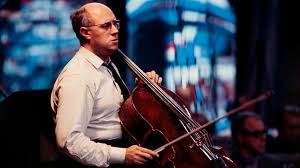
If twentieth-century musical history needed a single figure to capture the essence of earth-shattering force, magnetic authority, and untamed passion, that name would undoubtedly be Mstislav Rostropovich. The Russian master did not merely play the cello; he physically dueled with the instrument, extracting a monumental, high-voltage sonority that seemed to erupt from the very depths of the earth. While many players pursued a polished, polite, and sterile salon perfection, “Slava”—as he was affectionately known—transformed every single performance into an event of pure visceral electricity, where a truly transcendental technique served purely as fuel for a deeply human, urgent, and intensely tátil discourse.
To listen to Rostropovich today is to understand the true definition of virtuosity: a flawless synthesis between surgical clarity of articulation and a volcanic warmth that effortlessly shattered the barrier between the stage and the audience. He didn’t step onto the stage to casually execute a score; he climbed up to defend a cause, note by painstaking note.
The Magnet of Genius and the Shield of Freedom
Rostropovich’s talent and towering personality were so staggeringly absolute that he became the single greatest magnetic force of his era for the creation of new repertoire. He didn’t wait for history to happen; he actively molded it, inspiring and premiering well over one hundred new works. None other than Dmitri Shostakovich, Sergei Prokofiev, Benjamin Britten, Witold Lutosławski, and Henri Dutilleux wrote their monumental masterpieces with the specific hands and titanic breathing room of Slava in mind. He translated the expressionistic anguish of the Soviet era and the sweeping lyricism of the West with the organic ease of someone who commands the forces of nature.
Yet, his genius could never be contained strictly within the walls of a concert hall. Rostropovich was a towering giant of moral integrity and human liberty. When the Soviet regime attempted to crush the writer Aleksandr Solzhenitsyn, Slava courageously sheltered him in his own home. And when the Berlin Wall finally crumbled in 1989, there he was, cello in hand, playing Bach’s Suites amidst the concrete debris, transforming the sound of his instrument into the definitive global anthem for the liberation of a people.
The Crown Jewel: The Technical Knockout of Monumental Sound and Ferocious Attack
If you want to experience the true voltage and seismic impact of Mstislav Rostropovich’s genius without needing a roadmap or an instruction manual, your mandatory destinations are his definitive recordings of the Dvořák Cello Concerto or Shostakovich’s Cello Concerto No. 1.
The absolute jaw-dropping element in a Rostropovich performance lies in the sheer rawness and physical weight of his attack. The sound that emanated from his hands possessed an immense, room-filling volume, yet retained the crystalline transparency of fine glass. In the opening bars of the Shostakovich concerto, the rhythm he drives into the strings with his bow delivers an absolute technical knockout: the cello tears through the atmosphere with a savage, ironic aggression, propelled by an implacable, cinematic internal pulse. There were no notes scattered aimlessly to the wind; every shift on the fingerboard was executed with surgical precision and a wide, electric vibrato that made the wood of the cello weep, roar, and sing with an infectious physical presence.
The Invitation
Mstislav Rostropovich demonstrated to us that great music is not a dusty museum artifact to be locked away under a glass display, but a living, dangerous, and liberating organism that requires blood, sweat, and sheer audacity to truly mean something. He was the supreme global ambassador for art at its most noble, free, and completely enrapturing.
So, here is our invitation for your ritual tonight: set aside a moment of absolute pause, slip on your finest pair of headphones, and unearth the historic recordings of this eternal titan. Press play on the Dvořák concerto conducted by Herbert von Karajan, or the raw, rhythmic muscle of his Shostakovich. Close your eyes, absorb the massive impact of that incandescent touch, and let Rostropovich’s radiant solar energy drive your day forward.