
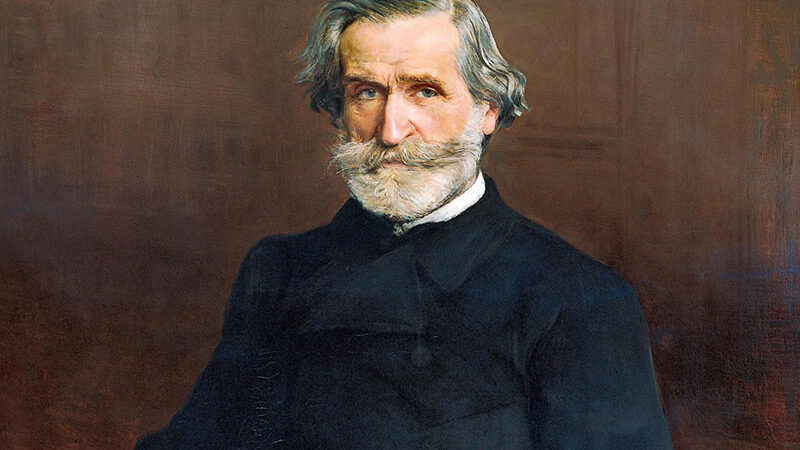
If Johannes Brahms was the quiet architect of the private heart and Liszt was the flash of lightning on a solo piano, Giuseppe Verdi was a roaring, technicolor tidal wave of human voices. Long before modern cinema used sweeping soundtracks to make audiences weep, gasp, and cheer in the dark, Verdi was turning the opera houses of Europe into epicenters of pure, high-octane emotional spectacle.
Verdi is the absolute king of musical drama. To put it in a way that clicks today, he didn’t just write classical music; he wrote the definitive anthems of a generation. He possessed a supernatural knack for capturing the rawest, most visceral human experiences—betrayal, forbidden love, political fury—and translating them into soaring, unforgettable melodies that the ordinary person on the street could hum by heart the very next morning.
The Choir of the Oppressed and the Accidental Revolutionary
Picture Italy in the 1840s. The country is fragmented, occupied by foreign empires, and yearning for freedom. Enter Verdi, a son of an innkeeper, who had just suffered the unimaginable tragedy of losing his young wife and two children to illness. Broken and ready to give up music forever, he was handed a libretto about the Babylonian exile of the Hebrew people.
The spark caught fire. From that grief-stricken darkness, Verdi wrote Nabucco. When the opera premiered, a specific chorus of exiled captives singing about their lost homeland—Va, pensiero—blew the roof off the theater. It wasn’t just a beautiful song; it was a luminous, solar ray of hope.
Ordinary Italians instantly adopted it as their secret anthem of resistance. Overnight, Verdi became a living symbol of freedom. His very name became a revolutionary code word scrawled on city walls. He proved that music could break out of the elite boxes of the aristocracy and march directly into the streets to unify a fractured nation.
The Crown Jewel: A Champagne Toast with a Heartbreaking Twist
If you want to experience Verdi’s genius for blending sophisticated glamour with a killer pop hook, you need to step inside the first act of his absolute masterpiece, La Traviata.
There is a jaw-dropping moment right at the beginning of the opera where the characters raise their glasses for a champagne toast, singing Libiamo ne’ lieti calici (The Brindisi). It is a melody so universally famous, so effervescent, and so inherently joyous that it feels like the ultimate celebration of life and luxury.
But Verdi’s real magic lies in the contrast: he hooks you with the intoxicating, sexy rhythm of the party, only to strip away the mask later on, delivering some of the most heartbreakingly fragile, emotional high-notes ever written for the soprano voice. It is music that requires zero preparation to enjoy; it bypasses the intellect and strikes right at the core of our shared humanity.
The Invitation
Verdi left us in 1901, and his funeral was the largest public gathering in the history of Italy—with a crowd of a quarter-million people spontaneously breaking into a tearful rendition of Va, pensiero as his casket passed by. He was a craftsman of the people, a man who never lost touch with the raw power of a great tune.
So, here is our invitation for tonight: turn up your speakers, pour yourself something sparkling, and let the sweeping, cinematic passion of Italian opera take over. Put on La Traviata or Aida, close your eyes, and let yourself be carried away by a composer who didn’t hide behind complex academic puzzles, but chose instead to make the human voice soar to the heavens. Open your heart and let the drama unfold.