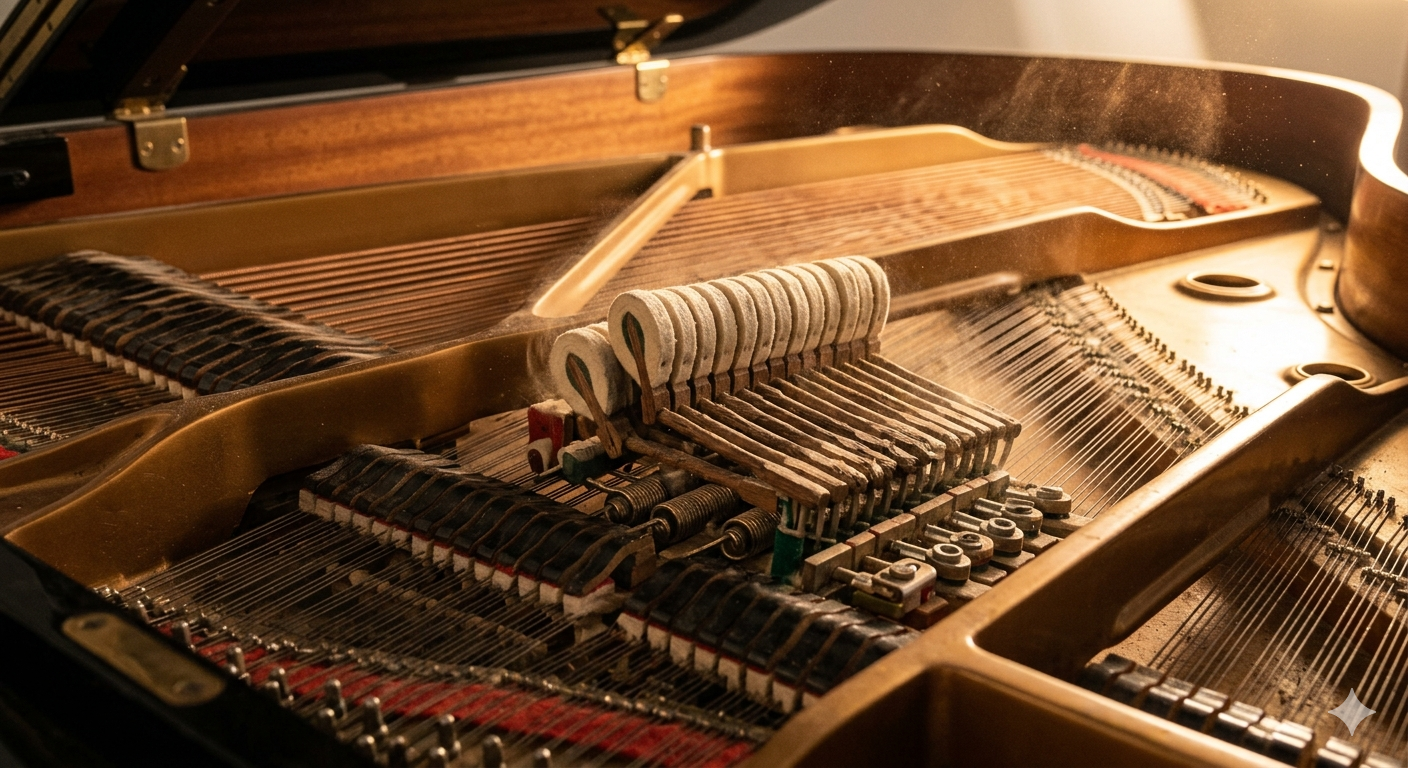
There was a defining moment at the turn of the nineteenth into the twentieth century when composers grew tired of telling traditional stories with a neat beginning, middle, and end. Instead, they decided to do something far more ambitious: they chose to paint. They discarded the rigid black lines of academic drawing and began to coat silence with pure brushstrokes of timbral color, floating textures, and light reflections. The score became a canvas; the orchestra and the piano, infinite palettes. When we listen to these masterpieces, our eyes lose their function because our ears begin to see. This is music in high-definition synesthesia.
1. Claude Debussy: Prélude à l’après-midi d’un faune
Royal Concertgebouw Orchestra | Conducted by Bernard Haitink
If musical Impressionism possesses an official birth certificate, it is signed by the solo flute that opens this masterpiece by Debussy. The faun awakens from his slumber beneath the suffocating heat of the afternoon, flirting with nymphs in a blurred, hazy dream. Under the baton of Dutch master Bernard Haitink, the Royal Concertgebouw Orchestra—universally celebrated for its velvet acoustic blend and golden woodwinds—delivers a millimeter-perfect reading. Haitink fiercely refuses to let the sound degenerate into an amorphous paste; he maintains a razor-sharp clarity through every single nuance. You can physically see the heat shimmering in the air, the sunlight filtering through the leaves, and the lazy, shifting contour of the faun. It is a total technical knockout achieved through pure atmospheric manipulation.
2. Camille Saint-Saëns: The Swan (from The Carnival of the Animals)
Orchestral Account
While the rest of The Carnival of the Animals operates as a witty, tongue-in-cheek parody, The Swan stands as an oil painting of painful nobility. Two undulating piano lines ripple incessantly, sketching the concentric circles and trembling reflection of a placid lake. Over this liquid carpet, the solo cello enters with one of the purest melodies in Western history, mirroring the aristocratic, silent gliding of the bird. The orchestration here creates a flawless acoustic optical illusion: the friction of the bow against the strings is so deeply tátil that it evokes the physical texture of feathers slicing through the mirrored surface of the water with absolute dignity.
3. Ottorino Respighi: Fountains of Rome (Fontane di Roma)
Minneapolis Symphony Orchestra
Where Debussy paints with delicate watercolors, the Italian master Ottorino Respighi unleashes heavy, monumental acrylics of blinding brilliance. Fountains of Rome is a symphonic poem carved into four distinct visual movements, tracking the sun’s trajectory across the eternal city’s water landmarks. In this historic account by the Minneapolis Symphony Orchestra, the dramatic voltage reaches its absolute peak during “The Trevi Fountain at Noon.” Here, the sound of water is no gentle whisper; it is the triumph of the god Neptune in a titanic orchestral crescendo of brass, organ, and percussion. This is pure cinematic sound: you can feel the physical impact of the heavy water jets slamming against the marble beneath a scorching, golden Italian sun.
4. Franz Liszt: Les Jeux d’eaux à la Villa d’Este (from Années de Pèlerinage)
Piano: Claudio Arrau
Decades before the French Impressionists claimed water as their ultimate playground, the Hungarian titan Franz Liszt had already cracked the code on how to transform the piano into a living fountain. In this genius page inspired by the gardens of the Villa d’Este in Tivoli, and under the hands of Chilean giant Claudio Arrau, the music takes on immense philosophical weight. Arrau utilizes his deeply tátil touch and legendary pedal control to make the notes in the piano’s extreme upper register glisten like water droplets atomized in mid-air, catching the sunlight before cascading back down into stone basins. Liszt even inscribes Christ’s words regarding “living water” into the score, and Arrau translates this mysticism with blinding spiritual and technical clarity.
5. Maurice Ravel: Jeux d’eau
Piano: Werner Haas
Directly inspired by Liszt’s structural framework, Maurice Ravel pushed aquatic painting to the absolute limits of pianistic engineering in his own Jeux d’eau of 1901. The motto engraved upon the score sums it up beautifully: “The river god laughing at the water that tickles him”. The pianism of Werner Haas—one of the supreme stylists of French keyboard repertoire—is of a razor-sharp transparency. Haas attacks the complex arpeggios and dissonant major-second harmonies with extraordinary, athletic agility. Ravel’s and Haas’s water is distinctly different from Liszt’s: it is wilder, highly geometric, packed with sudden whirlpools, waterfalls, and bizarre chromatic reflections. It is a technical knockout delivered by raw speed, pristine freshness, and purely visual virtuosity.
The Invitation
Music, when it dares to function as a painting, demands a total detachment from time. It invites us to contemplate the singular, fleeting instant.
So, here is our invitation for your ritual tonight: isolate yourself from all outer distractions, slip on your finest pair of headphones, and stroll through this gallery of invisible images. Feel the crisp chill of Ravel’s water, the staggering authority of Respighi’s marble, and the perfumed mist of Debussy. Close your eyes, shift your focus, and allow the music to paint your mind.