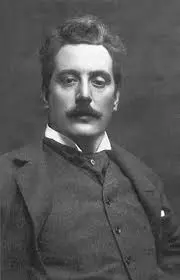
If Giuseppe Verdi was the grand, political voice of the Italian soul, Giacomo Puccini was the ultimate master of close-up human emotion. Long before film directors realized that combining a tight camera angle with a sweeping musical score could make an entire movie theater weep in unison, Puccini was already doing it on the opera stages of Europe. He didn’t just write operas; he wrote the late-19th-century equivalent of absolute box-office blockbusters.
Puccini is the undisputed king of Verismo—a musical movement dedicated to realism, bringing raw, everyday human stories to the stage instead of mythological gods or ancient kings. To put it into a modern perspective, he was the Steven Spielberg of classical music. He possessed a supernatural knack for capturing the most fragile moments of life—a young woman’s freezing hands in a Parisian garret, or a lonely sigh across a moonlit terrace—and blowing them up into melodies so luxurious, so solar, and so fiercely beautiful that they bypass your defenses entirely.
Fast Cars, Cigarettes, and the Art of the Tearjerker
Behind the deeply sensitive, heartbreaking melodies was a man who lived life in the fast lane. Puccini loved the finer things: he was a passionate hunter, a chain-smoker, a notorious romantic charmer, and an absolute speed demon who bought some of the very first sports cars in Italy. But when he sat down with his manuscript paper, that restless, high-octane energy transformed into absolute focus on the human heart.
He knew exactly how to manipulate time and tension. In masterpieces like La Bohème, he takes a group of poor, struggling young artists in Paris and turns their everyday life into something profoundly aspirational and poetic. You don’t need a manual of instructions to feel the chill of that cold room or the sudden, electric spark of attraction when two hands meet in the dark. Puccini writes music that feels tátil—you can almost feel the texture of the velvet night and the warmth of a shared glance.
The Crown Jewel: A Midnight Cry That Conquered the World
If you want to experience Puccini’s genius for delivering a jaw-dropping melodic hook that completely targets your nervous system, you have to look at his final, unfinished masterpiece, Turandot, and its legendary aria, Nessun Dorma (None Shall Sleep).
Set under the stars in an ancient, mythical Beijing, the aria is sung by an unknown prince who is gambling his life on a riddle of love. The piece begins with a quiet, tense mystery, but as it builds to the climax, the orchestra throws open the floodgates. When the tenor holds that final, triumphant high note on the word Vincerò (I will win), it is a moment of pure, unadulterated ecstasy. It is a melody so universally powerful, so cinematic, and so inherently epic that it has transcended opera houses to become a global anthem for triumph, played in sports stadiums and movies worldwide. It requires zero preparation to enjoy—it simply sweeps you off your feet.
The Invitation
Puccini left us in 1924, just as cinema was beginning to find its voice, but he had already written the definitive playbook for how music can amplify human drama. He proved that classical music doesn’t have to be a cold, intellectual exercise; it can be as vivid, urgent, and emotional as the greatest film you’ve ever seen.
So, here is our invitation for tonight: turn the room lights down, put on your absolute best pair of headphones, and let the cinematic genius of Puccini take over. Put on La Bohème, Tosca, or the sweeping tracks of Turandot, close your eyes, and let yourself be carried away by a composer who wasn’t afraid to make you cry, make you cheer, and make you feel alive. Open your heart and let the curtain rise.