If the history of human culture had to point to the exact moment when music ceased to be a polite courtly ornament or an exercise in classical symmetry and mutated into a tectonic force of pure physical impact and existential vertigo, that moment was the 19th Century. Musical Romanticism was not born to soothe or cradle the listener; it was born to dethrone reason. This was an era operated at an incredibly high electrical voltage, where composers chose to lay their own souls right on the knife’s edge and squeeze them into scores of unprecedented structural density. Forget the sugary clichés of pale poets dying of consumption—Romantic music is a formidable engine of steel and brio, featuring a lean, athletic style of writing completely stripped of unnecessary harmonic fat, yet thick with a physical presence engineered to scratch at the frequencies and fill the acoustic space with the weight of the infinite.
To listen to the Romantic era today with a high-fidelity pair of headphones is an astonishingly tactile experience. It means witnessing the birth of the modern orchestra as a high-definition organism, where the low frequencies gain the heavy weight of lead, the brass cuts through the air with military violence, and silence becomes a psychological suspense that is almost claustrophobic.
The Expansion of Metal and the Geometry of Chaos
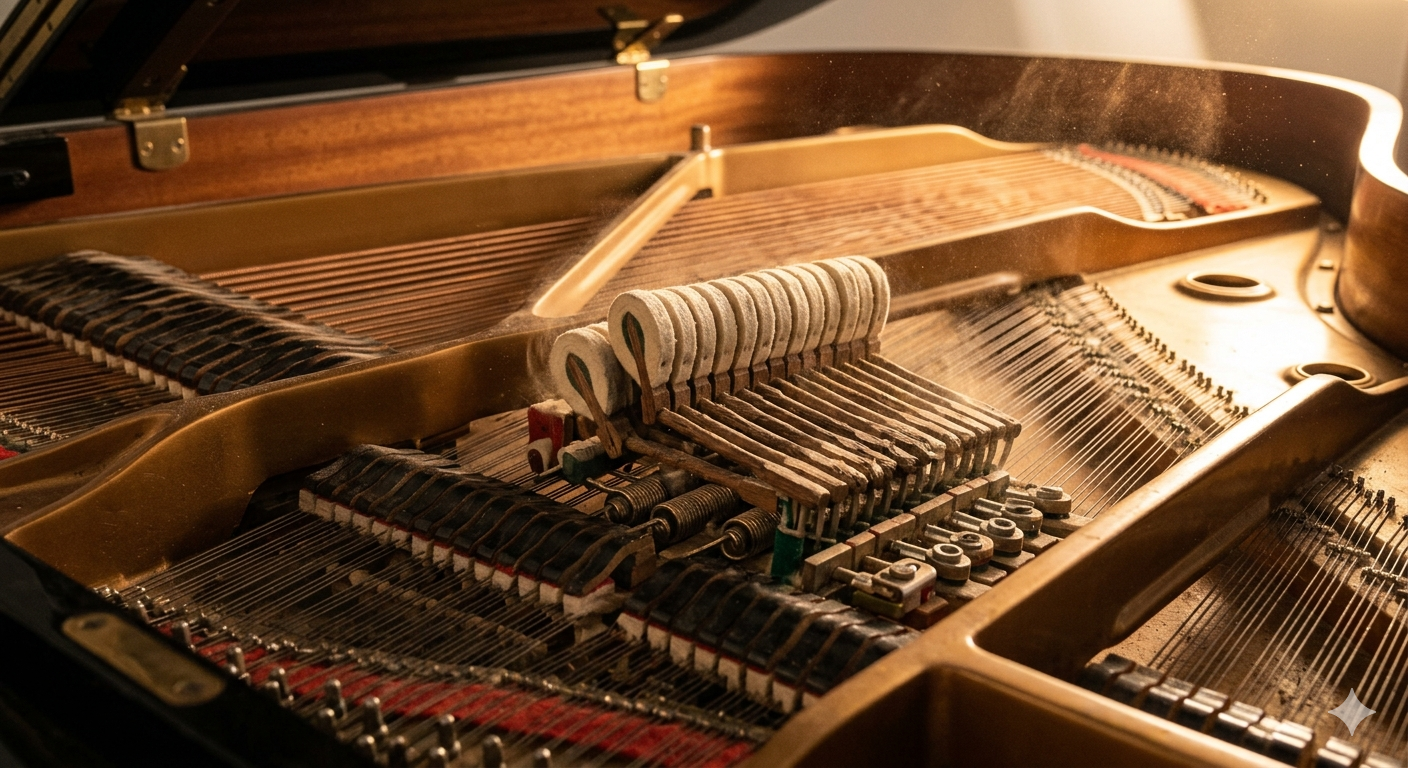
In the 19th century, the Industrial Revolution fundamentally altered the rhythm of the world, and music matched that machinery note for note. Instruments were radically redesigned: the piano gained a heavy cast-iron frame to withstand brutal percussive attacks, and woodwinds and brass received pistons and valves that permitted feverish chromatic modulations. Romantic composers became acoustic engineers obsessed with dynamic contrast. They realized that to translate the absolute, they required a genuinely three-dimensional sonic mass.
The true genius of this period resides within its manipulation of time. Through rubato—the freedom to stretch and compress the musical pulse—Romantic music creates a permanent physical traction, playing with the listener’s psyche. The elegance of classical structures was not destroyed; it was tensioned to the absolute limit by an agile musculature that deploys unresolved dissonances and abrupt modulations to keep the psychological voltage at its highest peak.
The Crown Jewels: From Berlioz’s Delirium to Wagner’s Sacred Weight
If you want to experience the authentic tactile rawness and dynamic impact of Romanticism without an instruction manual, your mandatory turning points reside within the acoustic punch of the March to the Scaffold (Symphonie Fantastique by Hector Berlioz) and the static suspense of the Prelude to Tristan und Isolde by Richard Wagner.
The jaw-dropping moment in the Symphonie Fantastique (1830) stands as a monumental landmark in orchestral engineering. In the fourth movement, Berlioz sketches a delirium completely stripped of any polite veneer. The rhythm drives forward with the sheer arrogance of a funeral march, anchored by pizzicato double basses and a dry, heavy attack from the timpani that hits the listener straight in the chest. The acoustic articulation demands high definition: you can feel the rustic friction of the strings and the raspy growl of the low brass biting into the mid frequencies with a sinister edge. When the guillotine blade falls, the blow is a dry percussive snap, followed by the frantic brio of the brass celebrating death—a definitive impact that fractures the floorboards of the studio.
Three decades later, Richard Wagner completely rewrote the DNA of Western music with the opening of Tristan und Isolde. The celebrated “Tristan Chord” cuts open the work not with a musical statement, but with a harmonic question that flatly refuses to resolve. The sound crawls forward in a whispered pianissimo across the violas and cellos, creating an environment that is claustrophobic and pregnant with meaning. There is zero cheap melodrama here; there is only the raw, physical reality of desire and suspense. The sound expands into dense, heavy blocks of brass and strings that ascend on a vertical line until exploding into a desperate cry of grief, leaving the listener entirely breathless in the absolute silence of the studio.
The Invitation
The Romanticism of the 19th century demonstrated to the world that music does not exist to describe reality, but to redraw it from the inside out. From Beethoven to Mahler, these men transformed sound into the absolute backbone of existence itself.
So, here is our invitation for your ritual tonight: isolate yourself entirely from the noisy static and frantic rush of the world, slip on your finest pair of headphones, and press play on these emotional gears. Seek out interpretations that fundamentally master the heavy voltage, structural weight, and sharp brio of these scores—such as the fiery, surgical precision of Claudio Abbado, the monumental rigor of Herbert von Karajan leading the Berlin Philharmonic, or the indomitable drive delivered by Sir Georg Solti. Close your eyes, absorb the three-dimensional impact of this sonic mass, and let the indomitable architecture of the 19th century entirely organize the chaos of your day.