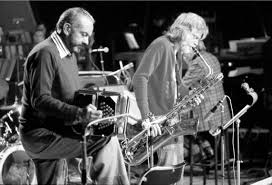
If the history of twentieth-century music preserved a single moment where the geometric melancholy of North American jazz and the passionate violence of Nuevo Tango fused into an indestructible organism, that moment occurred in Milan during the autumn of 1974. It was there that baritone saxophonist Gerry Mulligan and bandoneón master Astor Piazzolla locked themselves in a studio to record Summit (also released as Reunión Cumbre). This was no casual jam session or superficial exercise in “fusion.” It was the collision of two revolutionaries who had violently redrawn the borders of their respective genres. When the cavernous, velvety breath of Mulligan’s baritone collides with the slashing, almost percussive articulation of Piazzolla’s bellows, the result is a high-definition technical knockout: the sound gains a stark physical density, allowing the smoke of New York jazz clubs to hover directly over the damp asphalt of Buenos Aires.
To listen to this masterpiece today is to understand that true sophistication and dramatic weight require no orchestral excess. Backed by a razor-sharp rhythm section, these two giants sculpted a stark architecture of brutal contrasts and surgical dialogues.
The Collision of Two Revolutionary Schools
Astor Piazzolla had been fighting a lonely war in Argentina to prove that tango belonged in grand concert halls, not just traditional dance salons. He injected the music of Buenos Aires with the rigorous counterpoint of Bach and the sharp, complex dissonance of modern jazz. On the other side of the Atlantic, Gerry Mulligan stood as the prime architect of Cool Jazz, the man who famously proved that the baritone saxophone—a massive beast of heavy brass—could sound agile, weightless, and heartbreakingly lyrical.
On the album Summit, this duality transforms into absolute symbiosis. Mulligan willingly relinquishes the traditional bounce of swing to embrace the dramatic pulse, the heavy rubato, and the tragic accent of Piazzolla’s landscape. Conversely, the Argentine maestro carves out pristine pockets within his meticulous notation for the American to float with the raw freedom of a born improviser. There is no clashing of egos; it is an intimate conversation from master to master, where every single note carries the weight of an urban confession.
The Crown Jewel: The Surgical Impact of Years of Solitude and Deus Xangô
If you want to experience the authentic voltage and tátil rawness of this partnership without needing a roadmap or an instruction manual, your mandatory turning points lie within the cutting heartbreak of Years of Solitude and the rhythmic trance of Deus Xangô.
The absolute jaw-dropping element in Years of Solitude belongs to its melodic introduction. Piazzolla’s bandoneón enters breathing—the physical rasp of air tearing through metal reeds—drafting a painful, aching theme that feels like an urban prayer. When Mulligan’s baritone saxophone emerges, he refuses to compete in intensity; instead, he creeps in like a velvet shadow, a dark counterpoint embracing Piazzolla’s grief. The baritone sound here is so deeply tátil that you can practically feel the vibration of the wooden reed. The dynamic balance between both instruments operates with surgical precision: one smoothly clears the path for the other to explode.
Then, in Deus Xangô, the atmosphere shifts violently. The track is built upon a dark ostinato of piano and electric bass pulsing like a mechanical heart. This is Piazzolla’s most feverish, aggressive side in full swing. Mulligan’s attack here delivers a total technical knockout: he rips through the rhythmic foundation with biting, sharp phrases, proving that cool jazz could bite when provoked. The bandoneón answers with harsh, dissonant chords, shifting the track into a high-velocity cinematic thriller.
The Invitation
Gerry Mulligan and Astor Piazzolla demonstrate to us in Summit that geographic borders and stylistic labels completely crumble when music is driven by the pure urgency and truth of the urban soul. They proved that the dialogue between jazz and tango was not only possible, but monumental.
So, here is our invitation for your ritual tonight: isolate yourself from the noisy static of the world, slip on your finest pair of headphones, and press play on this meeting of titans. Feel the smoke, the heat, and the cold, sharp edge of this historic dialogue. Close your eyes, shift your perception, and let Mulligan’s breath and Piazzolla’s bellows entirely redraw the landscape of your mind.