
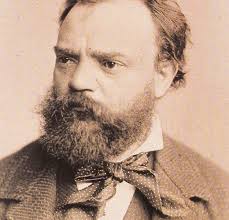
There are composers who write music for palaces, and there are others who write music for eternity. Antonín Dvořák belonged to an even rarer lineage: he wrote music with his feet firmly planted in the rich black soil and his heart tuned directly to the pulse of the common people. The Czech master was the ultimate hero of nineteenth-century musical nationalism—the man who proved that great art didn’t need to copy German academicism or Italian opera to be profound. For Dvořák, true sophistication lived in street dances, Bohemian folk songs, peasant rhythms, and the raw truth of popular traditions.
To listen to Dvořák today is an intensely tátil, physical, and solar experience. His music carries the scent of deep forests, the warmth of village festivals, and a melodic generosity that aims straight for the chest, blending a sharp, piercing melancholy with explosions of a boundless joy for living.
From Bohemia to New York: The Shock of the New World
Dvořák was already an international celebrity and a national treasure in his homeland when he received an irresistible invitation in 1892: to cross the Atlantic and direct the National Conservatory of Music of America in New York. The mission was monumental: to help American musicians discover their own creative identity, given that the country’s cultural scene was still entirely dependent on European models.
What the Americans didn’t expect was that this country-raised Czech man—who was famously obsessed with steam trains and breeding pigeons—would look precisely where no one else was looking. Instead of mingling in high-society salons, Dvořák immersed himself in the music of Southern plantations and Native American reservations. He listened intently to Black spirituals, native chants, and traditional folk melodies, and then fired off a prophecy that shocked institutional purists: “The future music of this country must be founded upon what are called Negro melodies. They are the foundations of any serious and original school of composition to be developed in the United States.”
The Crown Jewel: The Nostalgic Knockout of the New World Symphony
Out of this cultural collision emerged the definitive masterpiece that transformed him into an absolute myth: the Symphony No. 9 in E minor, Op. 95, universally known as the New World Symphony, premiered in 1893 to a roaring ovation at Carnegie Hall.
The piece is not a mere collage of borrowed American tunes; it is a cross-continental love letter. Dvořák utilizes the massive architecture of the classical symphony to weave the vastness of the American prairies together with a desperate, aching homesickness for his native Bohemia.
The jaw-dropping element arrives in the second movement (Largo). The music opens with a solemn sequence of brass chords that feels like the slow parting of time’s heavy curtains. Immediately after, the English horn enters, playing one of the most famous, heartbreakingly beautiful melodies in human history—a theme that floats like a solitary lament across the distant horizon line. It is so tátil you can practically feel the wind on your face and the heavy ache of exile.
Yet, Dvořák’s innate pop genius explodes in the fourth movement (Allegro con fuoco). The brass section attacks with a driving, tense, cinematic theme (one that, decades later, would serve as a direct inspiration for John Williams’ iconic score to Jaws). It is an immediate acoustic knockout, where the rhythm barrels forward with the unstoppable momentum of a steam locomotive tearing across the continent, boiling over with a solar energy that celebrates the future without ever abandoning the past.
The Invitation
Dvořák taught us that the most truly universal music is the kind that knows how to sing of its own village. He required no intellectual pretense or artificial posing; his artistic power came from the brutal honesty of his sentiments.
So, here is our invitation for your ritual tonight: find a pocket of deep quiet, slip on your absolute finest pair of headphones, and press play on the New World Symphony. Seek out readings that masterfully balance the dramatic weight with the syncopated swing of Czech dances, such as the legendary recordings of Rafael Kubelík leading the Berlin Philharmonic, the visceral interpretation of Leonard Bernstein, or the crystal-clear precision of István Kertész. Close your eyes, open your heart, and let yourself be carried away on this transatlantic voyage. Feel the immense impact of music that possesses a soul of pure earth.