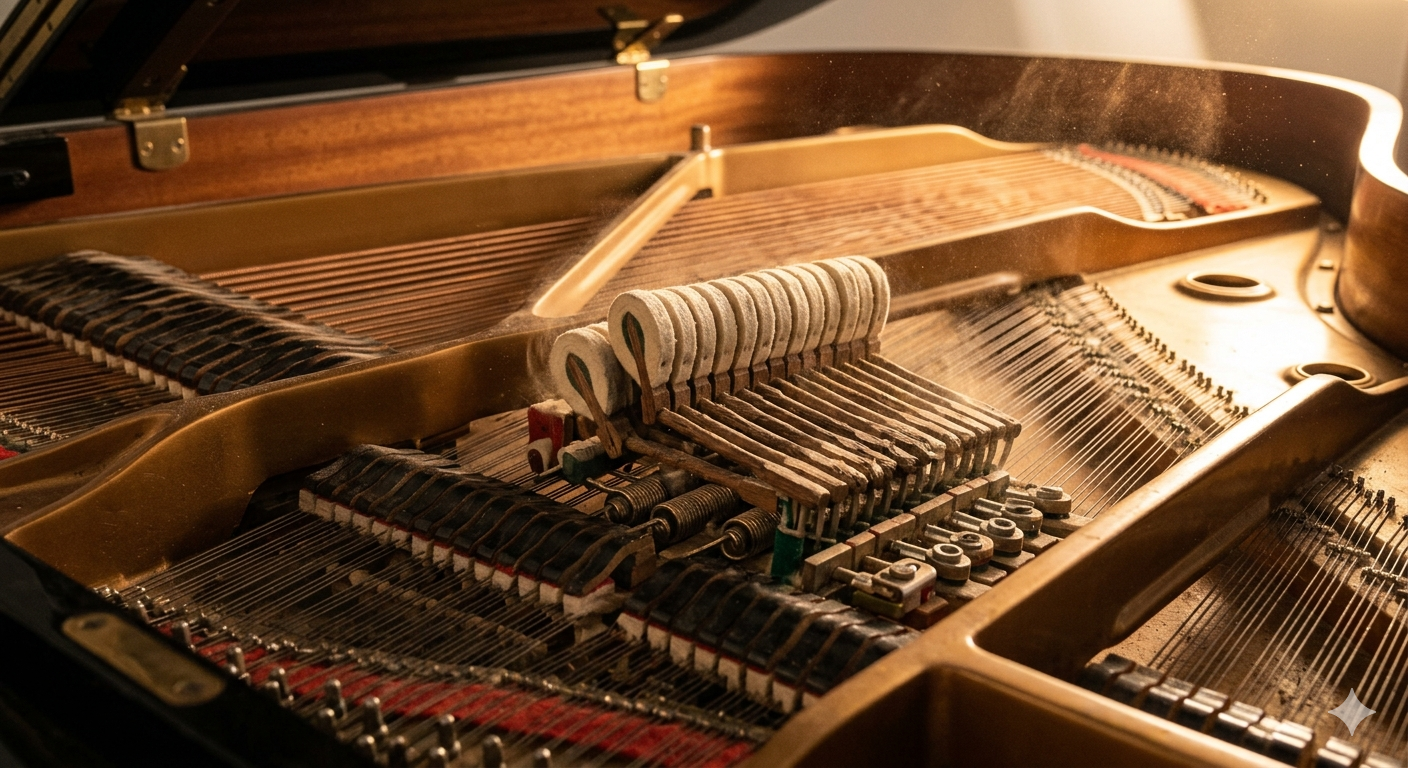
If the global history of classical music possesses an architect who took the fractures of the 19th-century human mind and projected them into a pianistic writing of absolute high voltage and psychological suspense, that name is Robert Schumann. The German master frequently suffers from the reductive cliché of being a composer of sweet lyricism or sentimental miniatures. In reality, Schumann operated at an unforgiving technical and conceptual voltage. He was one of the most radical acoustic engineers of his era, stripping the piano of symmetrical ornament to embrace a lean, agile musculature where rhythmic discontinuity, violent syncopations, and the sheer density of harmonic layers unite to deliver a profound, permanent physical impact. Schumann did not decorate time: he fractured it with absolute brio.
To listen to Schumann today with a high-fidelity pair of headphones is an astonishingly tactile experience. It means understanding that his writing demands physical presence—a surgical dynamic response capable of capturing the slashing sharpness of off-beat attacks and the electricity of polyphonic textures colliding head-on with the silence of the studio.
The Engineering of Conflict and the Geometry of Rhythmic Rubato
Schumann’s definitive signature in composition architecture was the creation of a permanent rhythmic instability through the obsessive use of syncopation and polyrhythms. He weaponized the piano as a dynamic battlefield, where both hands frequently operate in conflicting meters, destroying the perception of traditional pulse and creating a permanent physical traction that plays with the listener’s equilibrium.
This inverted mathematical precision—absolute control over chaos—is precisely what drives the voltage of his work. Schumann completely eliminates unnecessary harmonic fat to focus on a writing of bone and brio, where melodic lines scratch at tonal stability through abrupt modulations and dense harmonies. The sound gains an iron contour and a three-dimensional vividness that demands a razor-sharp attack and relentless mechanical force from the performer’s fingertips.
The Crown Jewels: The Feverish Attack of Kreisleriana and the Brio of the Piano Concerto
If you want to experience the authentic voltage and physical force of this pianistic engineering without an instruction manual, your mandatory turning points reside within the psychological storm of Kreisleriana, Op. 16 (Intermezzo I) and the mechanical impact of the Allegro affettuoso from the Piano Concerto in A Minor, Op. 54.
The opening movement and the subsequent Intermezzo I of Kreisleriana stand as landmarks of tactile rawness. The work erupts into a feverish whirlwind of sixteenth notes in the right hand, while the left hand executes heavy, displaced bass lines that beat like a malfunctioning engine through the studio space. The acoustic articulation here must be surgical: with reference headphones, you can feel the rustic resonance of the piano’s wood casing and the massive displacement of air in the low frequencies fracturing the silence. It is a claustrophobic sonic mass driving forward without a gasp of air, delivering a definitive acoustic impact straight to the chest.
Conversely, the polar opposite of symphonic brio strikes during the opening of the Piano Concerto. Following an initial punch from the orchestra, the piano cuts through the mix with a violent descent of heavy, percussive, staccato chords crashing down the keyboard with slashing aggressiveness. The sheer friction and brio demanded of the pianist are brutal: this is matter in a state of trance, operating with an unforgiving force that bites into the mid frequencies with military precision, proving that Schumann’s piano knows how to wound with indomitable elegance.
The Invitation
Robert Schumann demonstrated to the world that monumentality does not depend on linearity, but rather on the depth with which the mind’s contrasts are orchestrated. He transformed structural fragmentation into the absolute backbone of absolute Romanticism.
So, here is our invitation for your ritual tonight: isolate yourself entirely from the frantic noise and static of everyday life, slip on your finest pair of headphones, and press play on these gears of ebony and steel. Seek out interpretations that fundamentally master the tactile equilibrium and structural weight of this score—such as the fiery, surgical precision of Martha Argerich, the monumental electricity delivered by Sviatoslav Richter, or the raw, visceral virtuosity of Vladimir Horowitz. Close your eyes, absorb the impact of these infinite syncopations, and let Schumann’s indomitable engineering entirely organize the chaos of your day.