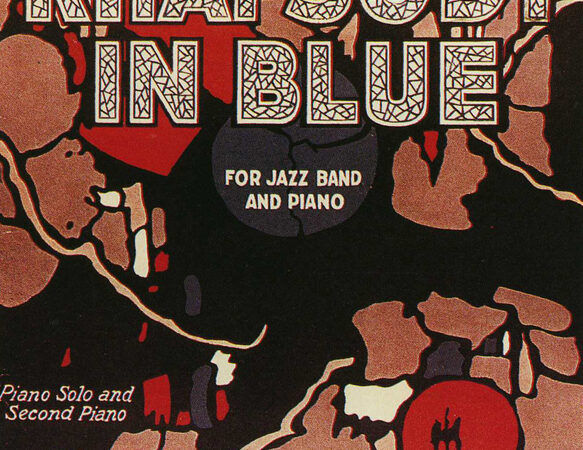
If the history of Western music boasts a definitive ground zero where the feverish asphalt of jazz and the marble of grand concert halls collided to create an entirely new organism, that landmark is George Gershwin’s Rhapsody in Blue. Premiered in 1924, the work was born from an audacious premise: to prove that American popular music possessed an architecture worthy of serious respect. Over the decades, however, countless orchestral interpretations scrubbed the grit right out of the piece, transforming it into something excessively polished. This is precisely why the 1976 recording conducted by Michael Tilson Thomas leading the Columbia Jazz Band—utilizing a roll tape featuring George Gershwin himself at the piano (recorded in 1925)—delivers a high-definition technical knockout. Here, the masterpiece rediscovers its original electrical voltage, its lean big band instrumentation, and its raw, swaggering, purely New York street accent.
To listen to this historic reading today is to witness a magnificent tear in time. We are not standing in front of a heavy, overblown symphony orchestra, but rather a razor-sharp jazz outfit where the sound gains a biting freshness and a muscular weight that strikes the listener right in the chest.
The Bellows of Progress and the Breath of Fire
Gershwin conceived the Rhapsody during a train ride to Boston, and the composer himself famously declared that the music was born as a musical kaleidoscope of America—its urban whirlwind, its machine-like rhythm, its frantic industrial dynamism.
In this recording with the Columbia Jazz Band, that mechanical and human energy pulses with surgical clarity. The decision to resurrect Ferde Grofé’s original 1924 arrangement for Paul Whiteman’s band changes everything. The sonic texture becomes leaner, drier, and infinitely more aggressive. The brass section of the Columbia Jazz Band does not merely float; it spits fire. The distinct textures of the saxophones, the banjo, and the crisp percussion provide a stark physical presence—a raw, tactile edge that lets the listener practically feel the heat of the streets and the thick smoke of 1920s jazz clubs. This is jazz in its most pure, insolent state.
The Crown Jewel: The Killer Glissando and the Ghost Piano
If you want to experience the authentic voltage of this historic partnership without needing a roadmap, your mandatory turning points lie within the iconic opening clarinet glissando and the fierce rhythmic movements where Gershwin’s own piano takes absolute sovereignty.
The jaw-dropping element strikes at second zero. The famous opening clarinet wail is treated here not as a mere technical adornment, but as a wild, urban howl that rips through the acoustic space with laser-like definition. The Columbia Jazz Band’s clarinetist delivers the transitional notes with a gritty malice and raw swagger that traditional symphony orchestras rarely, if ever, manage to replicate.
And then comes the piano. Thanks to the technology of the era, the pneumatic piano roll cut by Gershwin himself in 1925 was meticulously synchronized with the live band in the studio. The result is hauntingly brilliant. Gershwin’s pianism is electrical, athletic, and utterly stripped of any late-Romantic sentimentalism. The attack of his fingers on the keys possesses an unforgiving rhythmic rigor—a bite that grabs the band and shoves it forward. During the rapid-fire allegro sections, the dialogue between the composer’s “ghost piano” and the slashing horns of the Columbia Jazz Band creates a wall of sound that delivers a total dynamic knockout.
The Invitation
George Gershwin and the Columbia Jazz Band demonstrate to us through this historic reading that Rhapsody in Blue does not belong to a bucolic past, but to the driving urgency of the urban present. They stripped the academic dust right off the score, returning its most vital element: the danger and audacity of youth.
So, here is our invitation for your ritual tonight: isolate yourself from the noisy static of the world, slip on your finest pair of headphones, and press play on this legendary 1976 recording. Feel the initial impact of the clarinet rip through the silence, and let yourself get completely run over by the incandescent piano of Gershwin himself, driven by the absolute precision of the Columbia Jazz Band. Close your eyes, breathe in the golden dust of New York City, and watch this brilliant architecture of rhythm and blues completely redraw the end of your day.