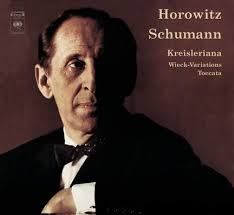
If the history of musical Romanticism required an architect to translate the exact duality of the human mind—torn between the purest sweetness and the abyss of madness—that architect would be Robert Schumann. Schumann did not merely write piano music; he transferred his own psychological diary onto the keys, fragmenting his persona between the poetic, dreaming Eusebius and the impetuous, feverish Florestan. Yet, for this universe of brutal contrasts to make sense outside of the manuscript, it demanded an interpreter with an electrical technical voltage and an almost mediumistic sensitivity. That man was Vladimir Horowitz. When Horowitz’s piano collides with Schumann’s score, the result ceases to be a conventional classical performance and transforms into a high-definition technical knockout: the sound gains a stark physical presence, a raw, tátil edge, and a sovereignty over dynamics that borders on the impossible.
To listen to Horowitz play Schumann today is to understand that the piano possesses no biological limits. He extracted a palette of colors from the instrument that ranged from the most ethereal whisper to the most violent thunder, never once sacrificing the surgical clarity of his articulation.
1. Kinderszenen, Op. 15 (Scenes from Childhood)
The Adult Gaze Upon Innocence
Kinderszenen was not composed for children, but rather as an adult’s nostalgic recollections of childhood purity. They are thirteen brief pieces, small poetic miniatures of a deceptive simplicity. In the hands of Horowitz, this work achieves a transcendental dimension. Where other pianists lapse into infantile or obvious sentimentalism, Horowitz applies a strict, surgical containment.
The crown jewel here is, inevitably, Träumerei (Dreaming). Horowitz’s touch on this piece is an acoustic miracle. He coaxes the piano into singing with a melodic line so continuous and velvety that it seems to hover entirely above the keys. Every single note is weighted with millimeter precision, creating an atmosphere suspended in time where the tear is contained and poetry reigns absolute. It is childhood sculpted in pure crystal.
2. Kreisleriana, Op. 16
The Fantasy of Madness and the Knockout of Contrasts
If Kinderszenen represents stillness and dreams, Kreisleriana is the erupting volcano. Inspired by the character Johannes Kreisler—an eccentric, borderline-insane chapel master created by writer E.T.A. Hoffmann—this work stands as the absolute apex of Schumann’s feverish genius. It consists of eight fantasies that alternate, without warning, between violent despair and the deepest imaginable lyricism.
Horowitz’s reading of Kreisleriana is legendary for its raw electrical voltage. The jaw-dropping element lies in the lightning rhythmic agility and ferocious attack he unleashes during the fast sections (Florestan). The bass registers of Horowitz’s piano roar with a monumental authority, while his right hand drafts feverish arpeggios with laser-like definition. Then, in the blink of an eye, he completely disarms the listener by stepping into the slow movements (Eusebius), where the sound implodes into a floating, deeply tátil melancholy. Horowitz never hides the music’s scars; he exalts Schumann’s obsession and untamed passion with a clarity that borders on terrifying.
3. Toccata in C Major, Op. 7
The Athletic Whirlwind and Technical Triumph
If you want to experience the ultimate technical knockout of pure virtuosity, the Toccata, Op. 7 is your mandatory destination. Schumann wrote this piece with the explicit goal of creating the most difficult work of his era—an unforgiving moto perpetuo requiring athletic stamina and superhuman digital precision (ironically, the composer himself permanently damaged his hands trying to tame his own keyboard writing).
What Vladimir Horowitz accomplishes with this score is one of the greatest feats in the history of recorded piano. The internal pulse he maintains is relentless, cinematic. While most pianists struggle merely to hit the double-stops at maximum velocity, Horowitz transforms the rhythmic whirlwind into a vivid sculpture of light and shadow. The sound is clean, slashing, and entirely transparent. There is no heavy pedaling to camouflage imperfections; each note strikes the ear with the physical impact of a crystal mallet. This is virtuosity placed entirely at the service of a radiant, overwhelming energy.
The Invitation
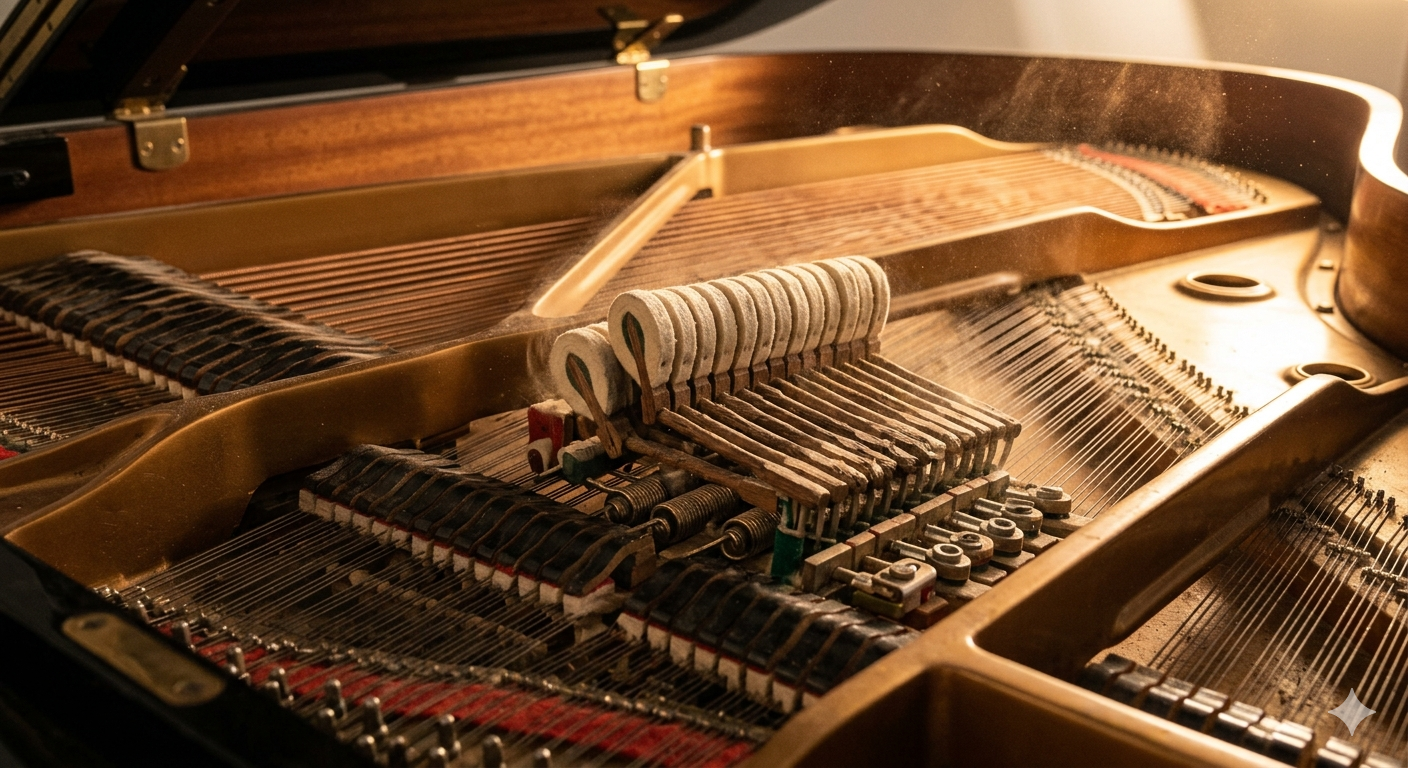
Robert Schumann and Vladimir Horowitz demonstrate to us that great art demands the courage to lay one’s soul completely bare, whether in the delicate folds of a childhood dream or the violence of a technical delirium. They proved that the piano, when approached with absolute audacity, ceases to be a construction of wood and metal, becoming instead a mirror of human existence itself.
So, here is our invitation for your ritual tonight: set aside a moment of absolute stillness, slip on your finest pair of headphones, and seek out the historic recordings of Horowitz interpreting these pages of Schumann. Press play on the sweetness of Kinderszenen, lose yourself in the labyrinth of Kreisleriana, and feel the seismic impact of the Toccata. Close your eyes, absorb the electricity of this incandescent touch, and let Schumann’s soul drive your day.