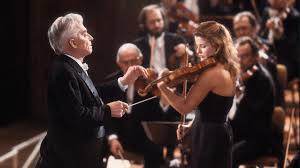
If the history of Western music boasts a single monument where the titanic force of an orchestra and the sovereign lyricism of a violin fuse into an indestructible structure, that monument is Johannes Brahms’s Violin Concerto in D Major, Op. 77. Written in 1878 for the virtuoso Joseph Joachim, this masterpiece categorically rejects the traditional concept of a concerto designed merely for a soloist to show off speed. Brahms conceived a symphony with violin obbligato—a true duel of giants where the solo instrument must rip through a monumental orchestral mass to impose its voice. And when this score meets the imperial reading of Herbert von Karajan steering the Berlin Philharmonic, alongside the surgical, incandescent precision of a young Anne-Sophie Mutter, the result is a high-definition technical knockout, where formal architectural rigor transforms into pure visceral, tátil electricity.
To listen to this historic recording is to witness the convergence of two distinct eras: the absolute master of the heroic German sound and his legendary protégée, shaping one of the most demanding pages in the entire repertoire with a clarity and emotional voltage that leaves the listener breathless.
Sculpting the Imperial Sound and the Debut of a Star
Brahms composed this work under the summer sun of Pörtschach, a peaceful Austrian lakeside town, which perfectly explains the pastoral, radiant light that weaves through the concerto despite its monumental weight. He took the grand symphonic tradition of Beethoven and expanded it, creating orchestral textures that are dark, rich, and deeply tátil.
In this definitive Deutsche Grammophon account, Karajan constructs a literal palace of sound. The Berlin Philharmonic unleashes that trademark velvet string tone and absolute precision of attack that became the Austrian conductor’s calling card. There are no blurs; the orchestral fabric flows with a magnetic, sweeping authority. It is into this vast sonic ocean that Anne-Sophie Mutter’s violin steps. Discovered by Karajan at just thirteen years old, Mutter displays an astonishing maturity here. Her sound is never timid: she attacks the score with crystalline purity, controlled vibrato, and a diverse range of dynamics that cuts through the opulence of the orchestra like a laser beam.
The Crown Jewel: The Technical Knockout of the First Movement and the Cadenza
If you want to experience the authentic voltage of this legendary partnership without needing a roadmap or an instruction manual, your mandatory destination is the dramatic transition leading into the violin’s entry and the monumental Cadenza of the first movement (Allegro non troppo).
The absolute jaw-dropping element lies in the raw contrast of forces. Following a lengthy, highly dramatic orchestral introduction, Mutter’s violin enters, shattering the atmosphere with a series of slashing chords packed with energy and tátil roughness. She doesn’t casually float above the orchestra; she forcefully imposes her will upon it. And when the solo Cadenza arrives—the section where the soloist plays entirely alone—Mutter delivers a masterclass in musical architecture and philosophical virtuosity. Every single string crossing, double-stop, and harmonic is desferido with surgical sharpness. The transition sliding back into the main theme, where the orchestra smoothly re-enters alongside the violin, is a miracle of balance and sensitivity managed by Karajan. It is raw, brute force brought to its knees before pure beauty.
The Invitation
Johannes Brahms, Karajan, and Anne-Sophie Mutter demonstrate to us through this recording that true virtuosity does not reside in a hurried rush or empty keyboard acrobatics, but in the rare ability to sustain dramatic tension and nobility of sound across space and time. They transformed a complex score into a living, imposing, and deeply human organism.
So, here is our invitation for your ritual tonight: choose a moment of absolute pause, slip on your finest pair of headphones, and press play on this legendary reading of Opus 77. Feel the massive impact of Berlin’s imperial sound open up the acoustic space, and let Mutter’s bow of fire guide your perception. Close your eyes, take a deep breath, and watch this magnificent architecture of light and shadow completely redraw the end of your day.