
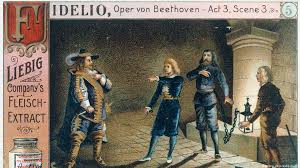
If opera history needed to pinpoint the exact moment when the stage stopped being mere court entertainment and became a burning political trench, that moment is called Fidelio. Ludwig van Beethoven spent his entire life fighting against the boundaries of musical form, but when he decided to write his only opera, he did something far more dangerous: he took human despair, the physical weight of iron shackles, and the obsessive quest for justice, and weaponized them into a sonic earthquake. Fidelio is no ordinary love story; it is an ethical and aesthetic knockout delivered straight against the face of oppression.
To listen to Fidelio today is an intensely tátil and liberating experience. Beethoven didn’t master the easy, formulaic conventions of the Italian musical theater of his era; instead, he treated human voices with the exact same monumentality and solar energy he unleashed through his symphonic instruments. The result is music that cracks the very walls of the theater and detonates straight inside the listener’s nervous system.
The Disguised Heroine and the Aesthetics of Rescue
The plot of Fidelio is a visceral punch to the gut. Florestan is a political prisoner rotting away clandestinely in the deepest depths of a dungeon, thrown there by the tyrannical governor, Don Pizarro. To rescue him, his wife, Leonore, makes an extreme decision: she disguises herself as a man, takes the name “Fidelio,” and secures a job working inside the prison itself.
Beethoven labored over and revised this opera obsessively for more than a decade. He thoroughly loathed the label of a commercial opera composer and desperately wanted to create a piece that perfectly mirrored his deepest Enlightenment and French Revolution ideals. In his hands, marital love is elevated into the ultimate driving force capable of tearing down dictatorships. The moment Leonore/Fidelio descends into the damp, pitch-black subfloors of the prison, the music abandons all trace of lightness and takes on a massive, crushing orchestral density where every note weighs as heavily as the lead of the convict chains.
The Crown Jewel: The Technical Knockout of the Prisoners’ Chorus and Leonore’s Cry
If you want to experience the authentic dramatic miracle of Fidelio without needing an instruction manual or a script, your mandatory turning point occurs at the end of the First Act: the famous “O welche Lust! (The Prisoners’ Chorus)”.
In this scene, the prisoners are granted permission to step out into the fortress courtyard for a few brief moments to breathe fresh air. Beethoven’s music emerges out of absolute silence and darkness with a fragile, trembling whisper from the string section. As the men slowly climb toward the light, the voices enter in a hypnotic crescendo, singing an anthem to freedom. It is a construction in breathtaking high definition, where you can practically smell the damp earth and feel the physical impact of the sun striking the skin of men buried alive. It is absolutely jaw-dropping.
But the definitive climax strikes in the Second Act, during the quartet inside the dark cell. Just as the villain Pizarro draws a dagger to assassinate Florestan, Leonore throws herself in front of her husband, pulls out a pistol, and unleashes the ultimate scream: “First kill his wife!”. In that exact split second, Beethoven completely cuts the orchestra and sounds a trumpet fanfare in the far distance, announcing that the Minister of Justice has arrived and the tyranny has collapsed. This is pure cinematic sound—a technical knockout that leaves the listener entirely breathless.
The Invitation
Beethoven taught us in Fidelio that music possesses the absolute power to shatter real and metaphorical iron bars. He proved that a monumental sound can become the voice of those who have been completely silenced by absolute power.
So, here is our invitation for your ritual tonight: wait for the dust of the day to settle, slip on your finest pair of headphones, and press play on this monumental vocal-symphonic fortress. Seek out readings that masterfully grasp the dramatic voltage and surgical precision of this score, such as the legendary recordings of Otto Klemperer (with a structural solidity of solid granite), the incandescent electricity of Leonard Bernstein, or the raw, crystalline precision of Claudio Abbado. Close your eyes, feel the crushing weight of iron transform into blinding light, and let yourself be entirely swept away by this hymn to human liberty.