
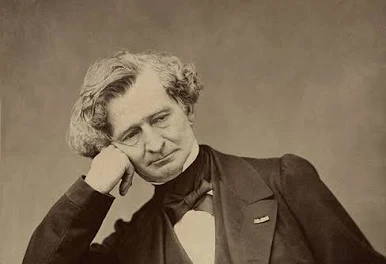
If the nineteenth century were scouting for a top-tier Hollywood screenwriter or a master of psychological suspense, it wouldn’t have to look very far. One only needed to turn toward France to find Hector Berlioz. While most composers of the era approached music through the architecture of the piano or traditional formal designs, Berlioz envisioned sound in raw widescreen. For him, the orchestra was not merely a collection of musicians; it was a special effects laboratory—a colossal, tátil machine engineered to paint vivid imagery, narrate intense romances, and, above all, deliver monumental impacts directly to the audience’s nervous system.
To listen to Berlioz today is the exact equivalent of stepping into an IMAX theater with the volume cranked to the absolute limit. He essentially invented modern program music—the kind that charts a narrative with a definitive beginning, middle, and end—and proved that orchestral sound could possess color, texture, scent, and an absurdly solar yet dangerous electricity.
The Maestro of Excess and history’s First Psychedelic Trip
Berlioz was a man possessed by absolute, consuming obsessions. He was utterly incapable of loving or creating halfway. His most legendary infatuation was his agonizing passion for the Irish Shakespearean actress Harriet Smithson. In a manic attempt to capture her attention—and exorcise his own internal demons—he penned his definitive masterpiece in 1830: the Symphonie Fantastique, Op. 14.
Long before psychedelic rock or digital effects, Berlioz etched into the sheet music the story of a fragile young artist who, plunged into despair by unrequited love, overdoses on opium and sinks into a terrifying series of macabre, delirious visions. He captured a singular melody—which he labeled the Idée Fixe (Fixed Idea), representing the woman he adored—and forced it to reappear across all five movements of the symphony, morphing its clothing and emotional temper as the hallucination intensified. It was a structural and psychological revolution that rewrote the rules of the game forever.
The Crown Jewel: The Technical Knockout of the March to the Scaffold
If you want to experience the unadulterated voltage of Berlioz’s genius without needing a manual of instructions, you must jump straight into the symphony’s fourth movement: Marche au Supplice (March to the Scaffold).
Deep within his drug-induced delirium, the artist dreams he has murdered his beloved and is being marched to the guillotine. The movement opens with a dark, heavy, ominous march tempo, where the timpani and brass create a tátil atmosphere of pure dread. The double basses and cellos mimic the heavy footsteps of the crowd gathering to watch the procession. It is a masterclass in flawless cinematic tension.
The jaw-dropping element arrives in the final seconds. The roaring mass drops away, yielding to a solitary, lonely solo from the clarinet, which breathes a final, fleeting fragment of the Fixed Idea—the artist remembering his love a mere second before the blade drops. Suddenly, the entire orchestra delivers a dry, brutal, thunderous chord, perfectly executing the violent impact of the falling blade. Immediately following, the drums roll with a bizarre, solar energy, celebrating the execution. This is the absolute virtuosity of orchestration placed entirely at the service of pure visual drama—an acoustic knockout that leaves you completely breathless.
The Invitation
Berlioz was a visionary largely misunderstood by the mainstream audiences of his day, who often dismissed his expansive works as merely loud and overblown. Yet, time ultimately vindicated him: today we recognize him as the true father of modern orchestration—the man who taught everyone from Franz Liszt to Richard Strauss, and straight down to modern Hollywood film composers, how to use sound as pure paint.
So, here is our invitation for your ritual tonight: kill the main lights in the room, slip on your finest pair of headphones, and press play on the Symphonie Fantastique. Seek out visceral, highly theatrical, and electrifying accounts, such as the legendary recordings by Sir Colin Davis, Leonard Bernstein, or the razor-sharp precision of Pierre Boulez. Close your eyes, open your heart, and feel the massive impact of this sonic tsunami. Let your imagination run wild.