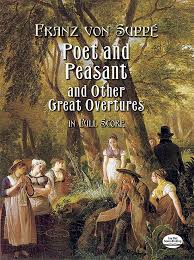
If you reach back into your mind for the finest memories of Saturday mornings from your childhood, watching classic cartoons like Woody Woodpecker, Mickey Mouse, or Tom and Jerry, then you already know this music intimately. The overture to the operetta Poet and Peasant (Dichter und Bauer), composed by the Austro-Hungarian maestro Franz von Suppé in 1846, is one of those rare gems in music history that achieved a spectacular feat: it broke out of the concert halls of Vienna to permanently colonize global pop culture. It is the absolute summary of what happens when orchestral rigor throws its arms around pure entertainment.
Listening to Poet and Peasant today is like taking a time-travel journey wrapped in high-definition production. The music is incredibly visual, tátil, and solar, structured like an emotional roller coaster that takes you by the hand and refuses to let you feel bored for a single second.
The Father of Viennese Operetta and the Secret of the Hook
Franz von Suppé was a true titan of musical theater. He essentially took French operetta, injected it with Viennese flavor, swing, and soul, and created a box-office phenomenon that drew massive crowds. He understood, like few others, how to construct a hook—that melody that latches onto the listener’s head upon first hearing and flatly refuses to leave.
While the complete operetta eventually became lost to time, its Overture survived as an independent monument. Suppé’s secret lay in playing with extreme dynamics: he was capable of painting the most absolute peace and, in the very next bar, throwing an orchestral party that made the audience want to jump out of their seats.
The Crown Jewel: From the Cello’s Song to the Thunderous Gallop
If you want to understand the pop genius behind this structure without needing a manual of instructions, you only need to pay attention to the cinematic transition happening right at the heart of the piece.
The work opens with a solemn, majestic brass fanfare, preparing the spirit. Immediately following, the atmosphere shifts completely as one of the most beautiful, lyrical melodies ever written for the cello enters—a tender, romantic solo that floats like a morning mist over the countryside. This is the “Poet” side of the music operating at its maximum emotional voltage.
Yet, the jaw-dropping element arrives with the technical knockout that follows. Without warning, the calm is shattered by a sharp, crisp chord, and the entire orchestra unleashes a thunderous gallop—a fast, energetic, and absurdly solar march rhythm (the “Peasant” side in full celebration). The violins race, the cymbals crash, and the sound spikes with an electricity so contagious that you can practically see animated images moving across your mind. This is virtuosity placed entirely at the service of pure joy, designed to make your nervous system vibrate.
The Invitation
Poet and Peasant is definitive proof that classical music does not need to be stiff, somber, or distant to be brilliant. It was born for movement, for the theater, and for real life.
So, here is our invitation for your next pause: crank up the sound system in your living room or slip on your absolute finest pair of headphones. Give this classic overture a spin—seek out vibrant readings packed with swing, like the legendary recordings of Sir Georg Solti or Herbert von Karajan conducting Suppé’s overtures. Close your eyes, smile at the childhood memories that are bound to surface, and feel the massive impact of a piece of music that will never grow old. Let that energy infect your day.