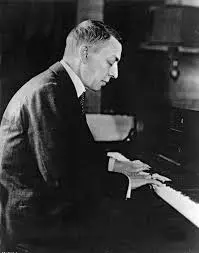
If Gustav Mahler pushed the symphony to the very edge of the cosmos, Sergei Rachmaninov did something perhaps even more daring as the nineteenth century drew to a close: he looked at the raw, unfiltered romance of the human heart and decided to turn the volume all the way up. Standing at a towering six-foot-six with a famously stoic expression, Rachmaninov looked more like a strict corporate executive than a romantic poet. But the moment his hands touched the piano keys, all that armor melted away, unleashing a tidal wave of pure, golden emotion.
Rachmaninov is the undisputed king of melodic luxury. To understand his massive impact on modern culture, you don’t need a music degree; you just need to listen to Hollywood. He basically invented the sonic vocabulary of the great silver-screen romance. His melodies possess a distinct gancho—a sweep and a yearning so structurally perfect and emotionally irresistible that pop icons, jazz musicians, and film directors have been borrowing his melodies for decades to evoke absolute passion.
The Great Crash and the Triumph of the Mind
Behind the grand, cinematic concertos was a deeply sensitive man who almost had his career destroyed before it truly began. When Rachmaninov premiered his First Symphony, it was a colossal critical disaster. The failure crushed his confidence so completely that he fell into a profound, paralyzing depression and didn’t write a single note for three years.
What saved him wasn’t an academic breakthrough, but a pioneer of hypnotherapy named Dr. Nikolai Dahl. Day after day, sitting in a dark room, the doctor would repeat a therapeutic mantra to the blocked composer: “You will begin to write your concerto… it will be of great quality… it will be a major success.”
The therapy worked miracles. From that psychological darkness, Rachmaninov burst back into the light with his Piano Concerto No. 2 in C minor. When the needle drops on this masterpiece, what you hear is the sound of a soul breaking its chains. It didn’t just save his career; it became arguably the most famous, beloved piano concerto ever written—a solar explosion of energy that proved true genius cannot be silenced.
The Crown Jewel: A Midnight Sigh on the Keys
If you want to experience Rachmaninov’s supernatural knack for writing a melody that targets your nervous system and requires zero manual of instructions, skip the fast-paced showpieces and head straight to the 18th Variation from his Rhapsody on a Theme of Paganini.
There is a moment of pure jaw-dropping genius here. Rachmaninov took a fast, aggressive, almost frantic little tune by the violin master Niccolò Paganini, turned the sheet music completely upside down, slowed the tempo down to a luxurious crawl, and handed it to the piano.
The result is a melody so breathtakingly beautiful, so cinematic, and so inherently romantic that it instantly sweeps you off your feet. It is tátil; it feels like the warmth of a sudden embrace in the middle of a velvet night. It’s no wonder Hollywood has used this exact piece for decades to score its most iconic, star-crossed love stories. It is music in its purest, most aspirational state.
The Invitation
Rachmaninov lived well into the mid-twentieth century, exiled from his beloved Russia and touring the world as a legendary performer, but his heart always remained anchored in the lush, sweeping romance of the late 19th century. He never apologized for writing beautiful tunes, and he never hid behind cold, intellectual riddles.
So, here is our invitation for tonight: turn the world off, grab a comfortable seat, put on your absolute finest pair of headphones, and let the velvet giant take over. Put on his Second Piano Concerto or the Second Symphony, close your eyes, and let yourself be carried away by a composer who knew that the shortest distance between two souls is a melody that refuses to let go. Open your heart and let it sweep you away.