
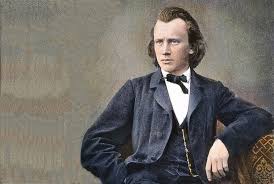
If Franz Liszt was the flashy rock star of the 19th century and Chopin was the poet of the velvet night, Johannes Brahms was something entirely different, yet equally captivating. He was the master of the slow burn. In a century obsessed with wild revolutions, spectacular scandals, and breaking all the rules, Brahms chose a quieter, much more sophisticated path. He decided that the old structures weren’t broken—they just needed a beating heart inside them.
Brahms is the ultimate musical craftsman. To put it in a way that resonates today, his music isn’t like a fast-paced Hollywood blockbuster; it’s more like a beautifully shot, deeply emotional indie film. It’s sophisticated, rich, and possesses a timeless, comforting warmth that wraps around you like a favorite cashmere sweater on a brisk autumn evening.
The Guardian of the Secret and the Heavy Shadow
For decades, Brahms lived under a monumental shadow—the ghost of Ludwig van Beethoven. The musical world expected him to be the next savior of the German tradition, a pressure so immense that it took him over twenty years to finish and release his very first symphony. He was a perfectionist who burned dozens of his own manuscripts because he felt they weren’t flawless enough for the world to hear.
But behind this gruff, bearded, perfectionist exterior was a man capable of the most delicate tenderness. For his entire life, Brahms carried a deep, unspoken, and intensely romantic devotion to Clara Schumann, the brilliant pianist and widow of his mentor, Robert Schumann. Because this love could never fully be realized in the real world, Brahms did what all true romantics do: he poured that burning, restrained passion straight into his music. He didn’t scream his feelings from the rooftops; he hid them beautifully within the architecture of his notes.
The Crown Jewel: A Golden Autumn Sunset in Four Movements
If you want to experience the absolute peak of Brahms’ ability to blend intellectual brilliance with pure, heartbreaking beauty, skip the academic analysis and dive straight into the third movement (Poco allegretto) of his Symphony No. 3 in F major, Op. 90.
There is a jaw-dropping moment right at the start of this movement where the strings introduce a melody so melancholic, so instantly nostalgic, that it feels like watching a golden autumn sunset fade into twilight. It’s a melody that has been sampled by jazz legends, pop stars (like Frank Sinatra), and filmmakers because its emotional hook is completely flawless. It doesn’t ask for a manual of instructions; it simply connects with the part of you that remembers old loves and quiet evenings. It is elegant, cinematic, and profoundly comforting.
The Invitation
Brahms left us in 1897, marking the twilight of the great Romantic century, but the steady, burning flame of his music hasn’t lost a single degree of its warmth.
So, here is our invitation for your next quiet Sunday or late-night wind-down: pour yourself a rich glass of red wine, turn the lights down low, and let Johannes Brahms take the wheel. Put on his Third Symphony or his late piano pieces (Op. 117), close your eyes, and let yourself be carried away by a composer who proved that the deepest waters always run still. Just open your heart and feel the warmth.